The
Cave
Double Fine Productions
Released in 2013 and criminally
overlooked by me until now, who doesn't like a bit of platforming
spelunking, courtesy of Ron Gilbert.
Caves have been at the forefront
of adventure gaming since the get-go (a colossal one comes to mind) so
why wouldn't Mr. Gilbert use it as a setting? And why not make the cave
the narrator?? A very sultry and droll one it is indeed.
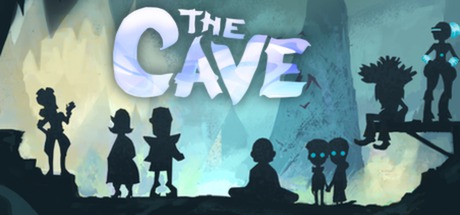
Whilst it's a single person game
(although you can apparently play co-op), you control a party of three,
each of them with their own special ability. You have to choose your
three explorers from seven available at the very start (the twins count
as one character) and off you go.
Each of the characters has a
special ability, which will likely be useful generally but will be
necessary to utilise in the character specific areas. The game consists
of a number of common areas, which you will traverse regardless of who
you choose as part of your team, and then an area for each of the seven
characters. Who is in your team will determine which of those areas you
have to traverse, and the special ability will be a necessary part of
successfully doing that.
But perhaps only mildly, in
terms of how often you have to use it. Suffice to say you won’t be able
to do it without it, but you may not have to use it very often.
Which doesn’t mean you might not
choose to use it a lot. I quickly learned that one of my character’s
abilities made light work of a recurring requirement in more than one
area.
If my maths is correct, you will
need to play three times to experience every area this cave has to
offer, which doesn’t even account for how the abilities of different
characters might impact how you solve various conundrums. Based on at
least one walkthrough there might be more than one way to solve a
conundrum, and each character also has two different endings, depending
on what you do just before you exit the cave (which you do through the
gift shop of course). The replayability quotient is therefore high.
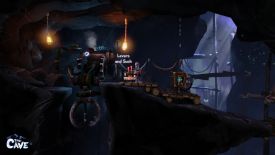
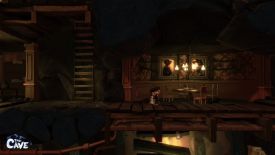
You progress through the cave
scrolling left and right, climbing up and down, pushing and pulling
items and jumping about. All three of your team have to regularly work
together, which is part of the problem-solving fun. You can mouse-wheel
between them, or utilise the little diagram bottom left; just choose the
appropriate image and you switch control. Get one to pull one lever,
another to pull a second, and run the third through the opening to be
able to move on.
Usefully there are times when
they all follow whichever character is active, eliminating the need to
go back and gather them individually. At other times, generally whilst
in the throes of solving a conundrum, you have to work them
individually.
I didn’t find the platforming
terribly difficult, including when timing was involved (i.e., doing one
thing with one character whilst another was e.g., providing a
distraction). Which isn’t to say it was all very straightforward, rather
that the biggest challenge came with how to solve the environment.
Which I did find challenging at
times. I certainly wouldn’t have worked out what to do on occasion
without a walkthrough. The solutions can be fairly elaborate, and some
thorough exploration will be necessary in order to begin to be able to
piece the answer together. You might then have to backtrack quite a bit,
or send your characters to disparate parts of the location in order to
set up and then execute what to do.
More than once I squealed with
frustration as a set-up failed and I needed to start over. Sometimes the
quickest way to do that was to ‘respawn’ by saving and exiting and then
continuing the game again (more of that shortly).
That also avoided what seemed
like might be permanent stuckness. Games used to do this, and whilst I
am loathe to blame the game rather than my own adventuring deficiency –
and noting that I have already indicated there seemed to be more than
one way to solve some conundrums – in one area in particular I could not
find a way around a misadventure, and a respawn seemed the best way out.
On the occasions I utilised that
as a deliberate strategy, my companions found themselves at a point
prior to my failure and with necessary items still in play. I might have
had a lot to do to again set what I was hoping to achieve, but e.g., the
rock I needed was still where I originally found it.
Let me reiterate – I don’t know
that I would have been permanently stuck. Rather, I chose a ‘solution’
that reset the game to letting me try again.
That aspect is somewhat more
complicated by the fact that the game exclusively autosaves to a single
save point. You just need to choose ‘continue’ from the opening menu and
you are back where you left off-ish. When the game autosaves I have no
idea; at no stage did I see any indication that it was occurring. What I
can say is that when you want to exit it will save, but what it won’t do
is restore you to exactly where you were. The first time I did this in
an attempted strategic manner was a result of having blown myself up. I
re-set the solution and just before engaging in the critical action, I
saved and exited. I was surprised to find when I re-entered the game
that my relevant character was standing nonchalantly in the vicinity of
the where I needed him to be and without the item he needed to perform
the action. I had to backtrack to where the necessary item was and then
bring him back to try again.
Which all sounds potentially a
lot more off-putting than it is. Whilst I would have preferred manual
saves at exactly where I left off, realising that ‘save and exit’ was
not going to dud me worked fine, and so not knowing when it might have
saved previously was rendered irrelevant. And the game never crashed, or
glitched or misbehaved in any way, so I was happy to rely on how the
exit function worked.
Plus it was always a bit of a
surprise as to where exactly I would be when I came back.
I should say too that the place
I respawned as a strategy was amongst my favourites. It involved
shifting time between past, present and future to create circumstances
in one that could be utilised by a character in another. Manipulating
all the bits and pieces was a highlight, albeit helped at times. Plus it
had the best visual joke in the game.
You can't die in The Cave, as
the cave will tell you, which really means you can die but get to try
again. The relevant character will just be resurrected a short way away
from the fatal move. My deaths were largely the result of falling too
far, drowning, or failing to run away quickly enough from a dynamite
blast. There are probably others.
You will pick up items, but each
character can only carry one item at a time. Holding an item will not
impede the character from climbing or pushing/pulling, but you might
need to drop items on occasion to given them to another character or to
pick up something different. It isn’t remotely inventory management, and
as a tip can I suggest you don’t drop an item unless you have to.
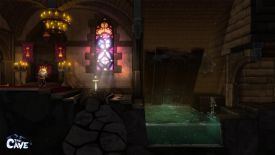
Your characters don’t speak, but
the cave and other characters do. Most of the sound is ambient/sound
effects and a soundtrack, and it works just fine. It has a quirky and
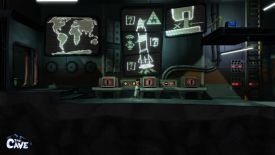
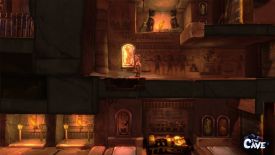
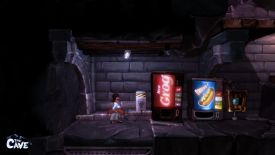
colourful visual style, and cutscenes punctuate events. Despite the lack
of dialogue it was sardonically amusing and even laugh out loud funny at
times. You can collect achievements (I found very few) as well as comic
book pages (I did considerably better).
The Cave has its foibles, but
depending on your use of a walkthrough I reckon you could spend at least
10-12 excellent hours in its underground presence (not counting doing it
again with other characters!).
I played on:
OS:
Windows 11, 64 Bit
Processor: Intel i7-9700K 3.7GHz
RAM:
Corsair Dominator Platinum RGB DDR4 32GB
Video
card: AMD Radeon RX 580 8192MB
GameBoomers Review Guidelines
January 2026
design copyright© 2026
GameBoomers
Group