|
By flotsam
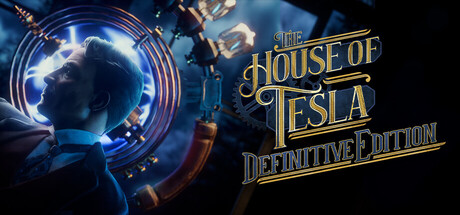
The House of Tesla:
Definitive Edition
Blue Brain Games
I don’t know terribly much about
Nikola Tesla, but I paid an earlier visit to one of Blue Brain’s Da
Vinci abodes, and it was enough me to make me visit here. I did a ‘first
look’ about 18 months ago, then an update, but never got to the final
game. So this ‘definitive edition’ release was the perfect opportunity
to reconnect and explore the rest of the house.
I was glad I did.
This version says that it is the
product of “everything we’ve learned since launch, and everything we’ve
improved based on community feedback.” Each Chapter has been reworked
for better flow, the graphics have been enhanced and there is a rebuilt
finale. As I understand it, it is what you get if you paid attention to
the things people said about your game and reworked it to address that
feedback.
I can’t say whether its better,
having not finished the earlier version, but I can say well done to the
makers for listening and responding to players.
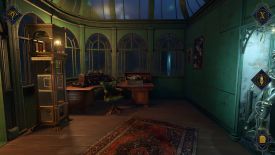
Things begin with Tesla
coming-to on the floor covered in debris. He has no memory of how things
came to this, but having dusted himself off he sets about inquiring.
Which starts in his office, and which functions as a tutorial for the
gameplay. Which is a good thing, as the interface isn't the most
intuitive I have experienced, and its also rather fiddly. If you have
played a Da Vinci you will know what to expect, but a refresher tutorial
might still be welcomed.
In short, it's all done with the
mouse and in the first person. You progress node to node by double
clicking, and at each node you can click and hold to drag the scene
around you, often through 360 degrees. Double click again to zoom in on
somewhere or something else, and perhaps do it again. Right click (and
perhaps again) to back out. The cursor changing to a magnifying glass or
a hand will indicate something that warrants further attention. On many
occasions you will also have to mimic actions (e.g., pull, turn, slide
etc.) with your mouse.
You will settle in, and its well
worth the effort, so don’t be put off if it feels cumbersome at first.
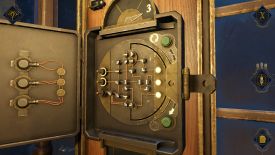
Whilst there is a narrative
going on as a result of the documents and ‘memories’ you find, this is
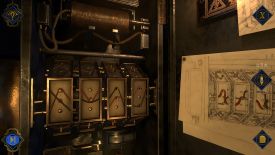
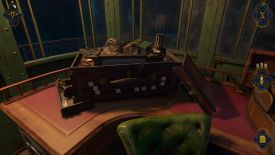
primarily about the puzzles. And there are so very many. Layers upon
layers of puzzling, many involving machines and contraptions, big and
small, clues littered through the drawings and other material you
collect. Build things, repair things, restore power to other things, or
simply guide a marble down a runway for no other reason than its another
puzzle. Various locations are like big puzzle boxes in themselves, the
Egyptian room being a favourite example. If there isn’t a collective
noun for puzzles, it should perhaps be Tesla.
Some puzzles are multipart,
others are just right there in front of you. Some are on a grand scale,
others far more intimate. Repair a full sized locomotive, move cargo
with a crane, pilot a toy tugboat, rewire the arm of an automaton and…
so much more.
I confess I had a ball, and
never got tired of the result of completing a puzzle being yet another
puzzle (well, perhaps a few times). They aren’t all like that, and when
more elaborate things happened in the gameworld it was always a buzz,
and at times even exhilarating. But another puzzle was never far away,
so if you like a few puzzles mixed in with your dominant narrative, this
isn’t the game for you.
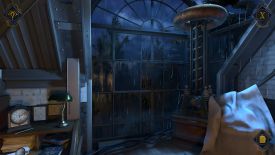
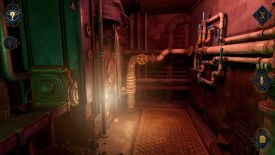
It looks spectacular, which
accentuates many of the puzzles. If they looked dull and uninteresting
they might begin to feel dull and uninteresting. Instead, many are
intricately beautiful in their construction, and even the most basic
have a degree of visual quality about them. More generally, there is
meticulous attention to detail throughout, and it feels real as a
result.
Sound wise, Tesla’s is the only
voice you will hear, and only in his flashback memories, everything else
being read (e.g., “there is no power here,” “I need something to make
that work”). Sound effects abound (though you won’t hear any footsteps),
and a changing soundtrack underpins things (I did turn it down).
Little animations accompany many
of your efforts, bringing to ‘life’ the factories and buildings you do
things in and the things you do within them, and more lengthy cutscenes
occur throughout. Tesla’s memories are presented via a sequence of
static scenes.
You will gather items but will
rarely have more than a few at a time. They sit left of screen, and some
have to be fiddled with or combined with another item to be complete,
indicated by an attached icon.
Two other things sit on the
left. One is a hint icon, assuming you leave it on in the options menu.
It will deliver a series of nudges building towards a more direct ‘what
to do,’ should you choose to click on it. You will have to wait a while
between nudges, but it certainly helps keep things moving along.
As does the ‘skip the puzzle’
icon, which will show up when that capacity is available. Not every
puzzle has that option, but rest assured that if it doesn’t, it is a
reasonably straightforward solve (except perhaps right at the end). You
will again have to wait a little while to use it, which encourages you
to keep trying, but when you have had enough just click the button and
the puzzle is solved.
Both those aspects, along with
the information in your journal, should ensure you never get bogged
down. I utilised both of them, and the former is particularly good in
terms of helping rather than just outright telling.
To the right of screen is the main menu icon, as well as your journal.
All your collected information is in there, as well as Tesla’s thoughts
on what he discovers, and a little scribbling sound and a visual
exclamation mark will indicate a new entry. Its bookmarked and well
collated, and I would recommend checking it out whenever it scribbles at
you. Clues and possible next steps abound.
The final icon to the
right enables you to activate a gizmo you will find very early, and
which enables you to see and re-route the flow of electricity. It
is important in solving a number of puzzles
I already said I
don't know much about Tesla, but a bit of research suggests the story is
wrapped around people and events in his life. I confess that I am
not sure I fully put together the threads of the narrative, but for me
that wasn't the main game so I didn't really care. That said, I
did enjoy what unfolded which made it much more than just an elaborate
series of escape rooms, although the denouement I am still not sure
about.
What else can I tell
you?
Some puzzles have a
reset button, but not many. Backing out of a puzzle doesn't reset
it, so once you start fiddling, you have to live with the results.
The game saves automatically when you exit and that is the only save you
have. You simply continue next time you play, although you can
pick the start point of any completed chapter should you want to.
How long it is will
depend upon how often you use the hint and skip buttons, but based on my
own experience and a bit of Googling, I can't imagine there is anything
less than at least a dozen hours here for most players, and perhaps half
that again. However long it takes you, if puzzles are your thing,
this is a house for you.
I played on:OS:
Windows 11, 64 bit
Processor: Itel
i7-9700K 3.7 GHz
RAM: Corsair
Dominator Platinum RGB DDR4 32 GB
Video card: AMD
Radeon RX 580 8192 MB
GameBoomers Review Guidelines
February 2026
design copyright© 2026
GameBoomers
Group
 GB
Reviews Index GB
Reviews Index |