|
By flotsam
Slice
of Sea
Mateusz Skutnik
Having just finished a rather
taxing puzzle-fest, I was looking for something a bit different and more
relaxing (brain-power wise). A whimsical visually enchanting journey
with a piece of seaweed sounded just the thing. Plus, I have wanted to
dip into the games of this maker by starting with his first. So it was
an apparently obvious choice.
It turned out to be an excellent
choice, albeit the brain didn’t get much of a rest!
Played in the third person, you
are Seaweed, who for some reason has put on a mechanical walking suit
and is roaming the dusty, desolate, nothing-like-the-ocean world beyond
the shoreline. There is nothing for it but to start walking, and see
where this quest leads.
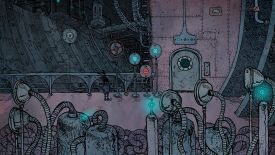
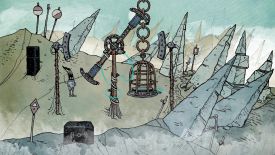
Visually it is captivating. Hand
drawn with ink on paper, the well over 100 separate screens are chock
full of surrealistic oddness. Creatures and objects float by or just
hang in the sky, gremlin-like creatures can be found in all sorts of
places, and Dali-esque “people" wander about ignoring you completely.
Things scuttle, but many just go about whatever their business is
languidly and deliberately.
There is an obvious entropy
everywhere, the trains and ships sitting stagnantly dilapidated upon the
sand. There are broken things and the bones of dead things later on. The
Town seems more alive, but it’s a comparative thing.
There is though power to
restore, things to activate and to interact with, switches and levers to
be pulled and pushed and numerous doors to open. Plus plenty of items to
find to help you do all that and even some things to jump on.
The important things to jump on
are fairly obvious, but jumping can also be involved in changing
‘planes.’ Seaweed moves primarily in the horizontal plane via the A and
D keys, moving left and right, but within that plane a jump might mean
he/she now walks up the hill instead of continuing along in front of it.
A jump might also be used to get him to enter a train door rather than
just walking past it; position him in front of the doorway and jump him
up to its opening, then head him inside with the W key. You only need to
do this if the doorway is not level with the ground (such doorways are
just entered using the W key), but it's worth knowing about.
There are often paths out of a
scene which again are accessed with the W key. Seaweed will walk ‘north’
(i.e., away from you) and the screen will change. These paths are marked
so you shouldn’t have trouble identifying when Seaweed can do something
other than simply exit a screen left or right, but be alert nonetheless.
While you move with the keyboard
(Spacebar does the jumping), you explore and interact with the world via
the mouse. The default curser is an old-fashioned pen nib, and it will
change in response to hotspots. You can’t reveal those so explore
carefully; it’s a mighty big world and finding the item you missed or
the device you didn’t turn on can take some doing.
Indeed, there are a few puzzles
that randomise each time you play and which if you haven’t physically
interacted with the relevant clue with your mouse, you can’t activate
that part of the puzzle. There might for instance be a puzzle with,
let’s say, four moving parts that need to be set correctly. You will
need to identify the relevant clue for each of the respective parts in
order to be able to interact with that part. This prevents any trial and
error – the puzzle simply won’t let you – so paying meticulous attention
is essential.
Which it is in many games, so
nothing too different here.
What is different and rather
interesting is that within a scene you generally don’t have to be
physically near a hotspot to interact with it. If you can see it,
chances are you can use it, so e.g., you don’t need to get Seaweed up to
the mezzanine above in order to be able to examine the chest of drawers.
You might even be able to unlock doors Seaweed is prevented from
reaching by some barrier, allowing him to then enter the room from the
outside. And if the power goes off when you step off the big button,
meaning that when you reach the door the lever won’t work, just stay
where you are and pull the lever from there - I confess more than once
to failing that aspect!
Seaweed is a driven sort of
character, with a jaunty step and a boundless enthusiasm for moving on.
More than once I was buoyed by his cheerful demeanour to keep pressing
on. His boundless energy was infectious, and I didn’t want to let him
down.
It was good that he was like
that, because as intimated there is a lot to do and a very big world to
do it in.
Many of the puzzles involve
inventory items, and Seaweed will gather quite a few. There are other
things he can gather as well (shells, coins) which provide an additional
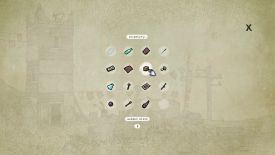
bit of ‘treasure’ hunting should you be so inclined. Right click brings
up the inventory, and then left click to try to deploy it. Some items
(codes etc.) can be examined within the inventory in the same way. I
didn’t ever combine items, but two were used together in solving one
puzzle.
Often the puzzle involves
sorting out what is required. Experimentation is recommended. On
occasions I did things that resulted in other things that made no sense
yet, but which I filed away for future use. There are times you will
have to pull together information gathered from widely disparate
locations, the connective tissue being present if you can piece it
together.
Indeed, while there were times
when I was stuck, and other times when I wondered where on earth to go
next. In retrospect I reckon there were only a few puzzles where the
intuitive nature of the solution still eludes me. For the rest, diligent
attention and thinking about what you have seen and done means you
should be able to join the dots.
Which doesn’t mean it is easy,
just that the game does (generally) provide. That said, it does have the
capacity to be unforgiving if you missed something.
There are a couple of puzzles
where timing is required, and you do need to jump on things. It isn’t at
all actiony but I thought it needed mentioning. And if you jump Seaweed
somewhere terrible (e.g., into a void) he just reappears from whence he
leapt.
Needless to say you will make
notes, draw pictures, record things you saw, maybe even draw maps. You
will note that certain sorts of things are present in this part of the
world, proximity to these things will turn them on, those other things
need something else to be activated. You will write down symbols and
where you saw them, and then link them to other places you also saw
them. It’s a rich tapestry.
You should certainly understand
your teleportation devices.
Very helpfully, given the size
of the world, there are teleportation beacons you can activate as you
go, allowing you to pop back to the location of any of them from any
other of them. Clicking one opens the portal interface, where you can
choose which you wish to travel to. Each of them is identified by a
symbol and a small line drawing of where it is located, but I found my
own notes about where each of them was, and more importantly what they
were in proximity to, more helpful. However a wrong choice – “I didn’t
mean to be here” – is easily remedied by activating and then choosing a
different beacon.
Quite late in the game you will
also come to possess a teleportation rune, which means you can access
the network just by clicking on the rune in your inventory (as opposed
to having to make your way back to a beacon). Rest assured you will use
the system, not just because you missed something, but by design. Some
puzzles have pieces many screens apart, both in time and space,
particularly a few towards the end. Whilst manually backtracking Seaweed
is possible, it is certainly less than desirable.
Having finished, I am not sure I
am any the wiser as to Seaweed’s mission, but it didn’t matter. The
vagueness is in keeping with its surrealistic tones, and enhances them
to a certain degree. Ditto the fact that there is no spoken word, and
very little written word, and that while there are very effective sound
effects, the dreamy soundtrack drapes everything in just the right
amount of uncertainty.
The game saves automatically
upon exit, which is the only save you can make. However, the first game
I started only ever had one save (later ones overwrote the earlier ones)
whereas the second time I started, each time I exited created a new save
point. Maybe I inadvertently turned something on, or maybe it was just
part of Seaweed’s grander weirdness. A single save point doesn’t bother
me, but you might want to get to the bottom of it if you feel
differently.
I spent about 12 hours with
Seaweed all up, and it was an excellent time. I look forward to moving
on to other games by this maker.
I played on:
OS:
Windows 11, 64 Bit
Processor: Intel i7-9700K 3.7GHz
RAM:
Corsair Dominator Platinum RGB DDR4 32GB
Video
card: AMD Radeon RX 580 8192MB
GameBoomers Review Guidelines
February 2026
design copyright© 2026
GameBoomers
Group
 GB
Reviews Index GB
Reviews Index |