|
By flotsam
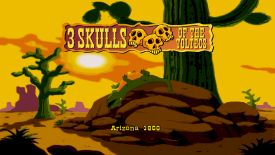
3 Skulls of the Toltecs
Casual Brothers, Ltd.
A game that has graced my shelves for years, in what I have always
thought was a good-looking box, like many of its fellow shelf dwellers I
had never played it. Until now that is.
First released in 1996, the version I played wasn’t the one in the box
but an enhanced version released in 2019. Near as I could determined the
game is the same save for the graphics, which have been smoothed and
upscaled to produce a sharper, more defined appearance. Toggle the
graphics in the menu to see the difference.
Plus of course it will run without furious fiddling on modern machines.
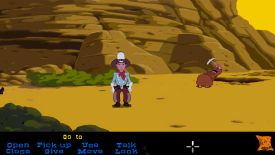
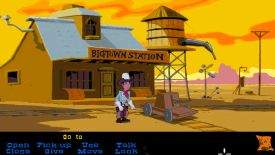
You play in the third person as Fenimore Fillmore, a cowboy roaming the
‘old west’ during the Franco-Mexican wars. A chance encounter and
subsequent gunfight puts him on the trail of three golden skulls said to
hold the secret to a legendary Toltec treasure.
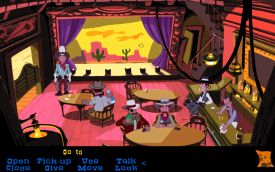
What follows is a varied point-and-click animated adventure involving
numerous inventory conundrums, conversation triggers, Wild Western
tropes and stereotypical characterisations, the last of which is
definitely showing its age.
Everything is done with a left mouse click. Moving Fenimore around,
exploring the game world, using inventory items, choosing your action
verbs; left click all the way.
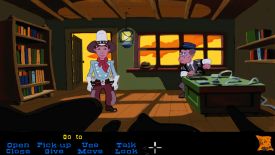
In keeping with its original age, a list of verbs sit in a ribbon below
the game world and you pick which action you want to engage in e.g.,
look, talk, give, use, pick up etc. Once activated, you click again on
where you want that action to occur - perhaps another character, an item
in the world or another inventory item. The action might then result or
Fenimore might say something like “that won’t work” or “I can’t do
that.”
Usefully the default action is ‘go to.’ which means that after trying
anything else that will be the active action, which makes moving
Fenimore around less convoluted than it might otherwise have been. That
said, his typical bow-legged single speed gait and some weird
peripatetic perambulations might well add a level of impatience to your
experience.
The default also means that if you want to look at everything in a
scene, you will need to choose ‘look’ each and every time. It would have
been nice to be able to lock-in an action until you wished to change,
but it’s a small thing.
As well as walking, getting around will (not immediately but early on)
involve a donkey and a rail-cart, and also a map. The map is the most
efficient mode of travel as it sits in your inventory and you can use it
at any time to access a different location. Should you prefer though,
you can make your way back to the exit point of your particular location
and then make your way overland to wherever you might want to go.
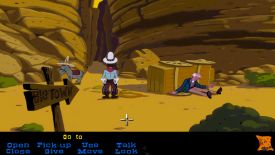
As you move your curser around the game world, it will generate a
relevant noun (rock, river, oven, Sheriff etc) just above the verb
ribbon when there is something you can interact with. Choose your action
and have at it.
It is an incredibly open game from very early on, which is a two-edged
sword. It means you can explore largely unhindered and if stuck just go
and explore somewhere else, but also that the appropriate next step may
not be close at hand. That wouldn’t matter so much if there was more
direction at times, making being stuck all the more bewildering. Whilst
my own failures were partly responsible, I did think it would have
benefitted by being a bit more constrained and/or by being a bit more
obvious at times as to ‘what next’.
It is a ‘take everything try everything’ inventory-based game and there
were things I would never have thought to try. Conversation puzzles also
exist, in that eliciting the right information is necessary to trigger
the way forward, and more than anything else I wasn’t always sure I knew
what that information was. Which meant erring on the side of exhausting
all topics, initiating conversations multiple times to achieve that,
which made it quite a garrulous endeavour.
Whether you find it funny will likely be a matter of taste. It tries
hard, but most of it didn’t land for me. It wasn’t helped by the various
racial stereotypes involved, which even in 1996 might well have been
seen as insensitive. I accept that the game is trying to “caricature
American Wild West themes” (to quote the GOG page), but it was all a bit
much.
It is voiced throughout, subtitles are available, and there is a
sporadic soundtrack along with a range of real and cartoony sound
effects. In conjunction with the visuals, the latter in particular gives
it the vibe it is looking for.
There are some sequences where you have to work out what to do in a
limited amount of time, otherwise the conundrum resets. It just means
you have to try again. The game saves automatically, and fairly
regularly, but there is no indication it is happening. It does save on
exit and you can just load that point next time, or scroll back through
the strip of film on the load screen to pick another scene.
I confess I made fairly frequent reference to a walkthrough, but I still
think there are at least 6 to 8 hours of animated western hi-jinks to be
had. And if you enjoy it, two subsequent Fenimore adventures exist.
I played on:
OS: Windows 11, 64 Bit
Processor: Intel i7-9700K 3.7GHz
RAM: Corsair Dominator Platinum RGB DDR4 32GB
Video card: AMD Radeon RX 580 8192MB
GameBoomers Review Guidelines
September 2026
design copyright© 2026
GameBoomers
Group
 GB
Reviews Index GB
Reviews Index |