|
By flotsam
Daymare Town
Mateusz Skutnik
I played Slice of the Sea from this maker not too long ago, and was
suitably impressed. I expressed a desire to play more of his games which
is how we find ourselves here.
The game begins with a short cutscene, in which a character (you?)
opines that the fog is encroaching and that there is nothing left to do
but to leave the town forever. You immediately find yourself in a small
piazza, buildings all around and a well in the centre, and off you go.
If point-and-click exploration is your thing this town has much to
offer. There is a lot to do and explore, much of it secondary to the
main path through the game but all of it compellingly fascinating. It’s
a big place with minimal direction, so be prepared to settle in for
meticulous searching.
Indeed, that aspect might be the game’s biggest potential drawback.
There are so many screens to explore with so often very little
indication of ‘what/where next.’ On many occasions I was just wandering
and looking, hoping to shake loose another item that might help me move
on. That I found many things I never even used just added to the
complexity.
What stopped it being an exercise in frustration was the world itself.
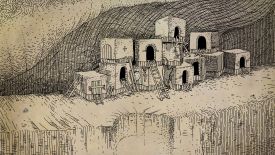
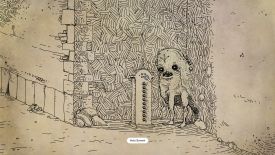
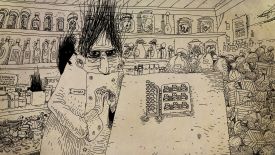
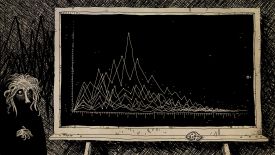
Made up of a series of hand drawn black and sepia pen-and-ink scenes, I
found it an engrossing place to be. It is a fantastical, detailed world,
each part unique but also part of a bigger whole. All sorts of stuff and
creatures can be found, and there are oh-so many doors to open,
characters to engage with and mechanisms to manipulate. Rummage through
pouches, boxes, cupboards and drawers, climb down holes, up ladders and
enter paintings. Find coins, spend coins, gather ‘collectables,’ chase
critters, fly a kite maybe and play game machines just for fun. And
more.
And even when there is nothing to do, like a picture book the scene
generally warrants your attention.
Converse as well with those you come across. They may have only a single
line of written dialogue or be capable of a slightly more detailed chat,
and they may shed (a bit of) light on your endeavours (e.g., “I am
thirsty”). Or not. That said, they might have something you need (even
if you don’t know it), so it pays to try and engage.
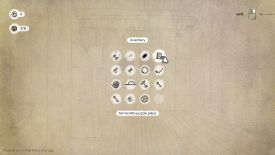
You will likely try to give them all manner of things. To do so, right
click to open the inventory,then choose an item to offer. Ditto for
using items in the broader game world. Some items can be combined.
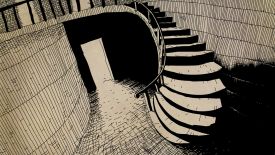
The visual style helped my engagement enormously. Simplistically, the
world looked good, but more than that, the scratchy nature of the images
helped sell the feeling of a town in decline. Whilst there are pockets
of normality, citizens still pushing against the encroaching fog, there
is a general malaise conveyed by the drawings (including in the
construction of the characters themselves) that never stopped being
intriguing. The design is equally impressive, different perspectives
being utilised (e.g., top down, side on, close-up, long shot) to
accentuate various aspects of the town, and despite the general lack of
motion there is a business going on in many scenes. I looked forward to
seeing what was down that alley, or behind that door, or in that hole,
and it helped keep me invested.
As did small ‘wins’ as I went and the ability to stop any time I liked.
Stepping away helped prevent frustration.
As noted, the tones are predominantly black and sepia, save for various
items in vivid white. Assuming that is that you aren’t playing on
‘hard.' In normal mode, objects you can collect will be white, helping
them stand out from the background, and your curser will react to
hotspots (take, look, use). None of that will occur though on hard.
It is entirely up to you (and you can toggle between them), but given
the scope of the ‘normal’ challenge I would recommend parking hard mode,
at least on the first playthrough.
The game world is large, and despite having regard to a walkthrough more
than once I am certain I didn’t see it all. I also only achieved a small
amount of the achievements available, a clear indication that there is
much left undone and many more hours to go.
Exit points will be indicated from each scene and there can be many of
these. It plays in the first person and you click through scenes, each
contained to what you can see on the screen (i.e., they don’t slide) and
you tend to back out of screens rather than turning around and moving
forward. I thought that aspect helped me remain oriented as I navigated
the environment.
You will find portals which will enable you to jump between locations,
and a portal stone found late in the game (assuming of course I didn’t
miss an earlier one) will further add to that ability. It takes some of
the sting out of backtracking.
Minimal but effective ambient sound is present, as is a sparse and
evocative piano accompaniment. The latter lifts the atmosphere, giving
it just the right amount of discordancy.
It saves on exit to a single save point.
I accept that visually this town might not be everyone’s cup of tea and
that the size of the canvass and the lack of direction might well put
people off. I might usually be such a person, but I nonetheless had a
thoroughly satisfying time.
I played on:
Lenovo Thinkpad X1 Carbon Gen 13
Intel I7 Ultra Core, 2.2GHz
Intel Arc 140V GPU, 16 GB
32 GB RAM
Windows 11, 64 Bit
GameBoomers Review Guidelines
October 2026
design copyright© 2026
GameBoomers
Group
 GB
Reviews Index |