|
By flotsam
Tormentum II
OhNoo Studio
Hailing from a very small indie Polish studio, the first Tormentum was
released way back in 2015. Inspired by the macabre art-stylings of Giger
and Beksiński, it was a grim hit. For a long time we thought we would
never see the stated follow up, and then suddenly here it was.
It landed with high expectations, given what came before. After nearly
10 hours of playtime, it pretty much lived up to them.
To paraphrase the makers, you play David, a man driven to build a
simulated world. His nightly dreams are of a locked chest and a woman's
voice calling to him. When elements of the dreamworld begin appearing in
his waking life, he accepts and installs an anonymously offered
co-processor. He wakes in chains in an island prison.
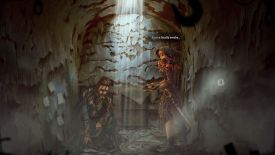
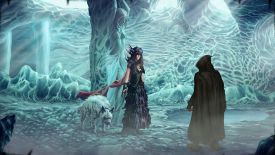
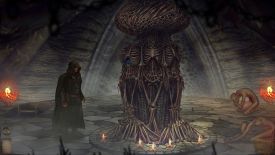
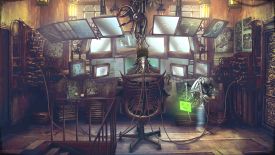
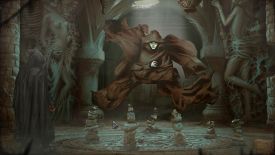
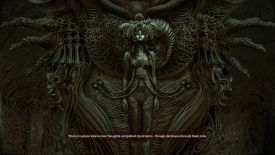
The game is a third person point-and-click feast for the senses.
Visually there are (apparently) 200 hand-drawn scenes, plus dedicated
close-ups that bring the total to nearly 500 individual background
images. Across the board they have that fluid biomechanical amalgam of
flesh and machine present in Giger’s work, and the largely monochromatic
tones mingled with the strategic use of colour help to produce a
fascinating almost visceral landscape, compelling and repulsive in equal
parts.
Sound wise, there is no spoken word (but lots to say and to think),
which I never mind as it means I can imbue the respective characters
with whatever ‘voice’ seems appropriate. It does mean you read a lot,
given how elaborate the story is, but it never became a chore. It’s a
weird, fantastical piece of storytelling, a tad convoluted perhaps but a
whole heap of grisly fun.
In the absence of voices, a stunningly effective score leads the way. I
am not usually a fan of the music in games, but here it does much of the
heavy lifting. From orchestral through choral to metal, sometimes
aggressive or sorrowful, other times soothing or grating, it both builds
and elevates the mood. Add in the excellent sound effects and a suitably
evocative atmosphere is created.
While each scene moves slightly at the edges, by and large what you can
see on screen is what there is, and rather than walking David about
within a screen, you explore with your mouse to find hotspots. Much
within each screen is static, but environmental effects (e.g.,
flickering candles, rain, water ripples etc.) are present in the vast
majority, and in conjunction with the cutscenes that punctuate the
events, the game world doesn’t feel remotely stagnant.
You make choices as you go. It isn’t clear that any of them are correct,
but it builds your version of David. Who David is might be different the
next time through, and the game might play out differently in certain
aspects. I egregiously and erroneously ground a potential companion into
a bloody smear early on which didn’t sit well with me for the rest of
the game. I look forward to seeing what might change if I make a
different choice.
Which you can do immediately should you want to, as the game allows you
to back out of any decision point before committing, and also allows you
to save at will to any number of save points. This means you can save
right before making a decision and observe the immediate effects of each
choice. The downstream impacts won’t of course be discernible, but this
aspect is open to you should you wish to utilise it. And whether you do
or not, who doesn’t like being able to save whenever and how often you
want?
Finding a hotspot with the curser (there is no capacity to reveal them)
will generate one of several icons (look, talk, take) and you click to
engage. A notepad sits bottom left which will automatically make a note
of relevant information, as will a map once you acquire it and which
will enable you to explore the broader world. Your inventory chest sits
bottom right; click to reveal your found items, then click one to try
and use it in the game world.
Puzzling is a mix of finding and using items, and discerning and
applying clues to straight out puzzles. It isn’t a hard game if you pay
attention, and I was more likely to be delayed by not having found the
necessary item/s (and you might have to explore well beyond the current
location to do so) than by not being able to fathom a puzzle. Where to
next might also be an issue, but the game tends to close off locations
and paths when they are no longer needed which assists in that regard.
I need to mention that there are a couple of puzzles near the end which
involve doing things fast enough to generate the solution. In response
to feedback, a recent patch has assisted in solving these puzzles (the
keyboard becomes your friend) but you still have to manage to do the
necessary things in a timely fashion. In my experience, it was certainly
better after the patch, but I would never have included them given they
are so different to everything that came before. A patch enabling you to
skip them would be even better, but kudos to the makers to listening to
players.
All up, I had a ball with this tormented time.
I played on:
OS: Windows 11, 64 Bit
Processor: Intel i7-9700K 3.7GHz
RAM: Corsair Dominator Platinum RGB DDR4 32GB
Video card: AMD Radeon RX 580 8192MB
GameBoomers Review Guidelines
August 2026
design copyright© 2026
GameBoomers
Group
 GB
Reviews Index GB
Reviews Index |